
Brazil and the rise of the Evangelical vote

For use by institutional investors only. Not for use with the general public.
Key takeaways:
- The rapid spread of evangelical Christianity has transformed Brazil’s political landscape
- Religious affiliation is increasingly influencing political outcomes and economic preferences
- As the country heads to the polls, what might be the potential implications for investors?
In his influential 1905 thesis The Protestant Ethic and the Spirit of Capitalism, the German sociologist Max Weber set out to explore the connection between the Reformation and the advent of Western capitalism.
Weber argued that Calvinism’s emphasis on predestination – the belief that God had already chosen who will be saved and who will be damned – generated a profound psychological anxiety among believers. Searching for signs of salvation, the faithful alighted on success in worldly pursuits as potential evidence of divine favour.
Yet because early Calvinism’s strict asceticism discouraged luxury and conspicuous consumption, wealth was not spent but reinvested. The result was a potent combination of industriousness and frugality that helped underpin the emergence of modern capitalism.
More than a century after its publication, Weber's thesis remains contested. Nevertheless, his broader insight, that shifts in religious belief can have far-reaching social and economic consequences, continues to resonate. Indeed, his central proposition linking Protestantism and capitalism has taken on a very modern relevance in an unexpected place.
The pulpit and the ballot box
One of the most striking cultural shifts in Latin America over recent decades has been the rapid growth of evangelical Protestantism, nowhere more so than in Brazil. Since the turn of the century, the country's Protestant population has roughly doubled, with around one-third of Brazilians now identifying as evangelical. This represents a remarkable transformation for what was once one of the world's most Catholic nations.
For investors, this is more than a curiosity of religious demography. As evangelicals have become a larger share of the electorate, they have emerged as an increasingly important political constituency, with significant implications for the country's economic direction.
I'm a Believer
Evangelical Christianity in Brazil has nearly doubled since 2000
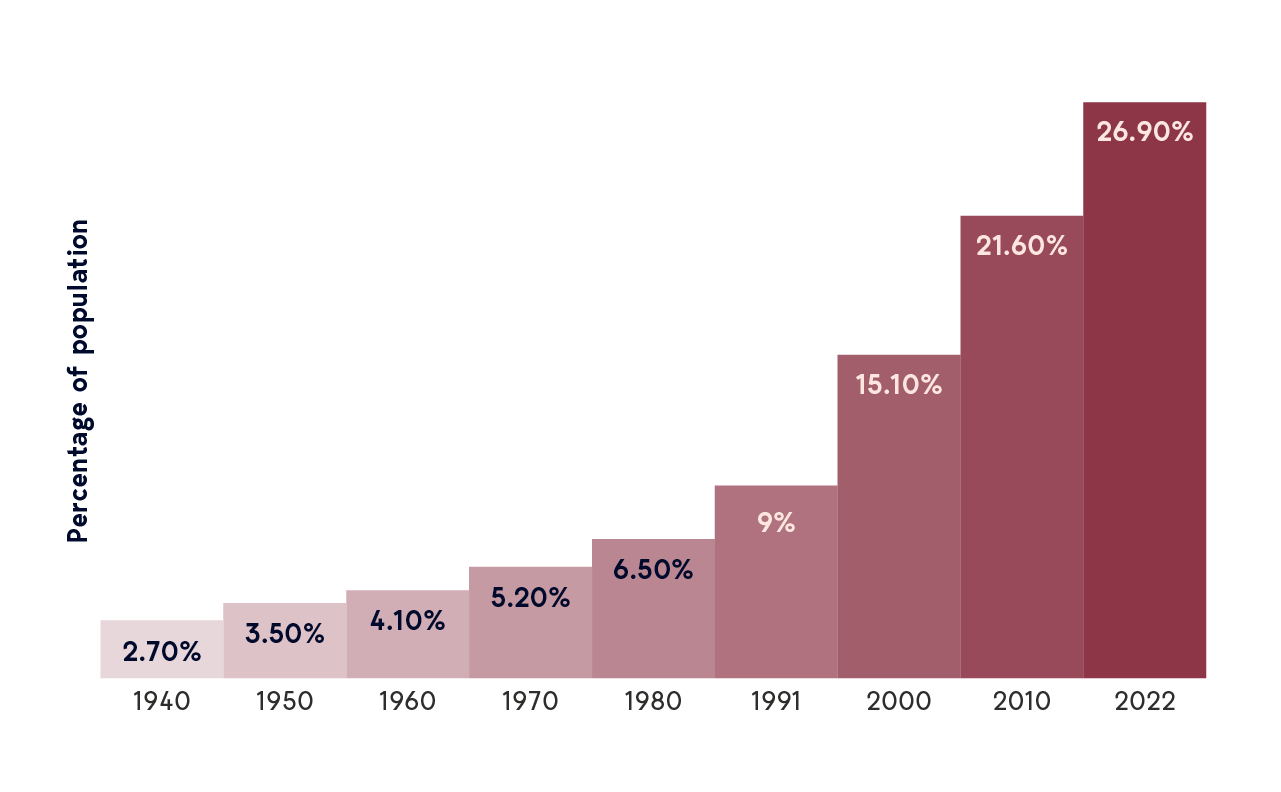
Source: IBGE, Demographic Censuses; 2022 Census, Religion: preliminary sample results.
Religion has become a powerful predictor of voting behaviour in Brazil. In 2022, evangelicals overwhelmingly backed the right-wing incumbent Jair Bolsonaro, while the reverse was true for Catholics, with most giving their support to the centre-left Workers' Party (PT) candidate Luiz Inácio Lula da Silva (Lula).
This split reflects differing attitudes towards a range of issues, notably crime and social policy. Economic management is another. Some researchers have argued that, with their emphasis on self-reliance and discipline, evangelical churches instil more entrepreneurship and market-oriented behaviours in their congregations. Whether cause or correlation, the pattern bears more than a passing resemblance to Weber's original thesis.
A similar confessional divide is expected when Brazilians return to the polls on 4 October. This time round, the candidate of the right will be Flávio Bolsonaro, prominent evangelical and son of the former president. In Lula, he will be coming up against one of the most formidable political operators of the 21st century.
Fundamentals over politics
Listening to portfolio companies, it’s clear that the evangelical vote is taken very seriously. During a meeting at our Edinburgh office in September, Dennis Herszkowicz, the insightful CEO of software company TOTVS, argued that it would prove decisive in delivering a Bolsonaro victory over Lula.
With Brazil representing the portfolio's largest country overweight, would such an outcome be positive from an investment perspective?
In truth, most portfolio companies appear largely indifferent to the result, at least from an operational standpoint. During a recent meeting, the CEO of pharmacy chain Raia Drogasil (RD) suggested that whoever occupies the Palácio do Planalto is of limited consequence to the business.
Over the past 15 years, RD has navigated left- and right-leaning administrations, a presidential impeachment, and multiple inflation and interest-rate cycles, all while maintaining an impressive growth trajectory. Its fortunes are driven far more by ageing demographics and the accompanying healthcare demand, and no election result is likely to alter those fundamentals.
Herszkowicz struck a similarly relaxed tone. Like RD, TOTVS has prospered under governments of differing political persuasions, reflecting the strength of its underlying growth drivers rather than the ideology of the administration in Brasília.
By contrast, oil and gas business Prio has more riding on the outcome. Prior to Lula's election, Prio was a beneficiary of Petrobras's divestment programme, acquiring mature offshore assets that no longer fitted the state-controlled producer's strategy. Lula subsequently halted the programme, while Bolsonaro has pledged to revive it. Should that occur, CEO Roberto Monteiro confirmed Prio will explore further acquisition opportunities in the Campos Basin.
Time for change?
But if companies were broadly sanguine about the election's operational implications, a stronger political preference emerged when the discussion turned to Brazil’s future.
Herszkowicz believes voters are tired of Lula and are ready for a fresh start. Yes, the economy has been more resilient than expected, but a reform-minded government would strengthen business confidence and encourage investment. Tackling some of Brazil's longstanding fiscal rigidities, notably the indexation of public-sector wages and pensions, should be top of the agenda.
Whether such reforms ultimately materialise remains uncertain. Brave (foolhardy?) is the politician who takes on pension benefits. However, at the margin, a government better able to address Brazil's fiscal constraints could provide a more supportive backdrop for an economy that has long struggled to realise its full potential.
That this owes something to shifting religious demographics in a country many thousands of miles from where he wrote his groundbreaking essay would likely be a source of surprise and no little satisfaction for Max Weber.
Important Information
This article is provided for general information only and should not be construed as investment advice or a recommendation. This information does not represent and must not be construed as an offer or a solicitation of an offer to buy or sell securities, commodities and/or any other financial instruments or products. This document may not be used for the purpose of an offer or solicitation in any jurisdiction or in any circumstances in which such an offer or solicitation is unlawful or not authorised.
Stock Examples
The information provided in this article relating to stock examples should not be considered a recommendation to buy or sell any particular security. Any examples discussed are given in the context of the theme being explored.