

Chips, clouds, and China

For use by institutional investors only. Not for use with the general public.
Key takeaways:
- Investor focus on semiconductors is obscuring strong fundamentals elsewhere in the AI chain
- China is rapidly advancing up the value-added ladder, and not just in AI
- The market is replete with good companies that have been overlooked in the AI charge
In the last Market Insight, we commented on mounting investor anxiety over the conflict in the Middle East. This angst largely dissipated in the second quarter, with the tentative US-Iran ceasefire prompting a collective sigh of relief in markets. Indeed, outright zeal was evident among a narrow group of companies in the semiconductor and semiconductor equipment arena, where the build out of AI continues to generate excitement. This subset of the technology sector collectively rose 55% in US dollar terms over the period, albeit a number of these companies have recently been giving back some of their gains.
Several leading ‘nuts-and-bolts’ enablers of AI infrastructure, such as foundry company Taiwan Semiconductor and chip lithography company ASML, posted strong gains. But at the forefront of the charge were a number of more-cyclical companies, including several memory businesses. This reflects burgeoning demand for high-bandwidth memory (HBM) chips, the specialised memory integrated into AI accelerators. NVIDIA’s graphics processing units, for example, require massive amounts of these chips to support AI workloads.
The extent of the semiconductor-related surge is highlighted in the chart below which shows the total returns of all stocks in the MSCI World Index and their percentage contribution to index returns. The pink circles are the top ten contributors to index performance. Several of the big benchmark behemoths such as Alphabet, Amazon and NVIDIA posted solid gains over the quarter, although their influence on the index is also a function of their size. What is remarkable is the sheer magnitude of some of the gains in the semiconductor arena (although AI chip kingpin NVIDIA significantly lagged its peers), with companies such as memory semiconductor maker Micron Technology rising 242% and accounting for 8% of the index return. Seven out of the top ten index return contributors were semiconductor-related stocks.
The semiconductor surge
Chip stocks were significant contributors to Q2 index return
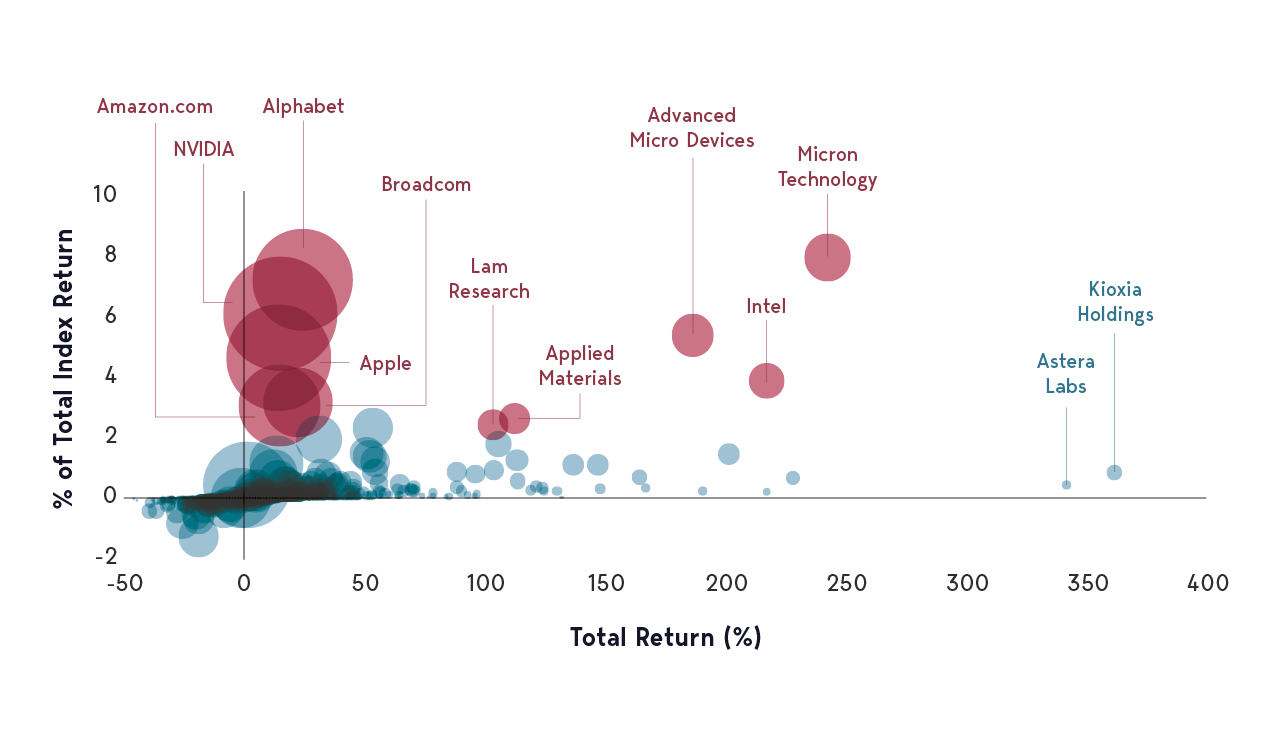
N.B. Astera Labs is a fabless semiconductor company, while Kioxia Holdings is the memory semiconductor business spun out of Toshiba. The size of circles represent weighting within MSCI World Index. Blue circles are the remaining constituents of MSCI World Index.
Source: MSCI. As at 30 June 2026. Chart shows MSCI World (ndr) Q2 2026 total return versus percentage of total index return. Returns shown in USD. Past performance is not a guide to future performance and returns may also increase or decrease as a result of currency fluctuations.
The recent passing of former Federal Reserve Chair Alan Greenspan brings to mind his famous comment about ‘irrational exuberance’ – a remark he made in a 1996 speech in the early stages of the dot-com bubble. So, is AI starting to effervesce a bit too exuberantly?
The overcooked and the overlooked
The answer is nuanced, with parts of the AI spectrum appearing frothy after recent gains while other areas have lagged. Investors have particularly rewarded the ‘scarcity’ narrative, i.e. bottlenecks in the system – from memory chip shortages to constrained capacity at TSMC and several wafer equipment makers.
With the prices of their products rising, this cadre of hardware businesses is indeed making huge amounts of money. This means that cloud service providers (CSPs), such as Amazon and Microsoft, are being forced to wear an increase in input prices, while at the same time investing massive amounts of cashflow in increasing data centre capacity. This double whammy has compounded concerns about the eventual return on this huge investment in AI, a sentiment reflected in the patchy share price performance of some CSPs in the year to date.
We believe that these concerns are overblown. We would argue that because compute capacity is also in shortage, compute prices are increasing. As such, CSPs should be able to pass through capital expenditure-related inflation. And if the return economics were to be challenged, they may choose to moderate future investment spending, with the supply chain potentially suffering more than the CSPs.
The fundamentals of Microsoft and Amazon remain highly encouraging, in our view. Not only are their cloud services business accelerating rapidly thanks to AI-related demand, but profitability has been on a rising trajectory.
Still under a cloud
The AI disruption theme continued to play out in the software sector this quarter. As mentioned in the previous ‘Market Insight’, we’ve been applying an analytical framework to assess the durability of incumbent software companies’ competitive moats.
We look to address key questions. Does the business provide critical, hard-to-replicate workflows for its clients? Does it possess valuable proprietary data? Do its customers operate in an industry with stringent regulations, where there is little room for reporting or data error? How successfully is it incorporating AI to strengthen its existing product or service offerings? As long as we believe a company’s fundamentals continue to stack up, we won’t be swayed by market perceptions.
A good example is cybersecurity company Fortinet, which was previously subject to AI disruption concerns about the prospect of a new breed of GenAI cyber companies posing a threat to its business. The company’s first-quarter results, which were comfortably ahead of expectations, provided affirmation of its strong fundamentals. Crucially, the company is benefiting from rising demand as cyber threats become more complex in the wake of the growing proliferation of AI.
China the disruptor
Head of Research Alan Lander and Investment Manager Tom Miedema were in China recently, weighing up the growing prowess of the country’s technology companies. There too, AI remains a central focus, with much of the recent progress underpinned by the development of competent open-source models.
Monetisation of AI, however, remains at an early stage, while constraints in the form of access to high-performance chips continue to present a challenge. Alongside this, substantial investment is being channelled into emerging areas, such as AI-enabled robotics, where hardware capabilities are advancing rapidly, even if broad commercial applications are as yet less apparent.
In contrast to the tepid condition of its domestic economy, Chinese industrial activity has been relatively buoyant. China is now a leading force in advanced manufacturing and technology, with many companies in the vanguard of innovation. It is noteworthy that according to the World Intellectual Property Organization, 49% of all world patent filings in 2024 came from China.
China to the fore
Breakdown of world patent applications by region/country
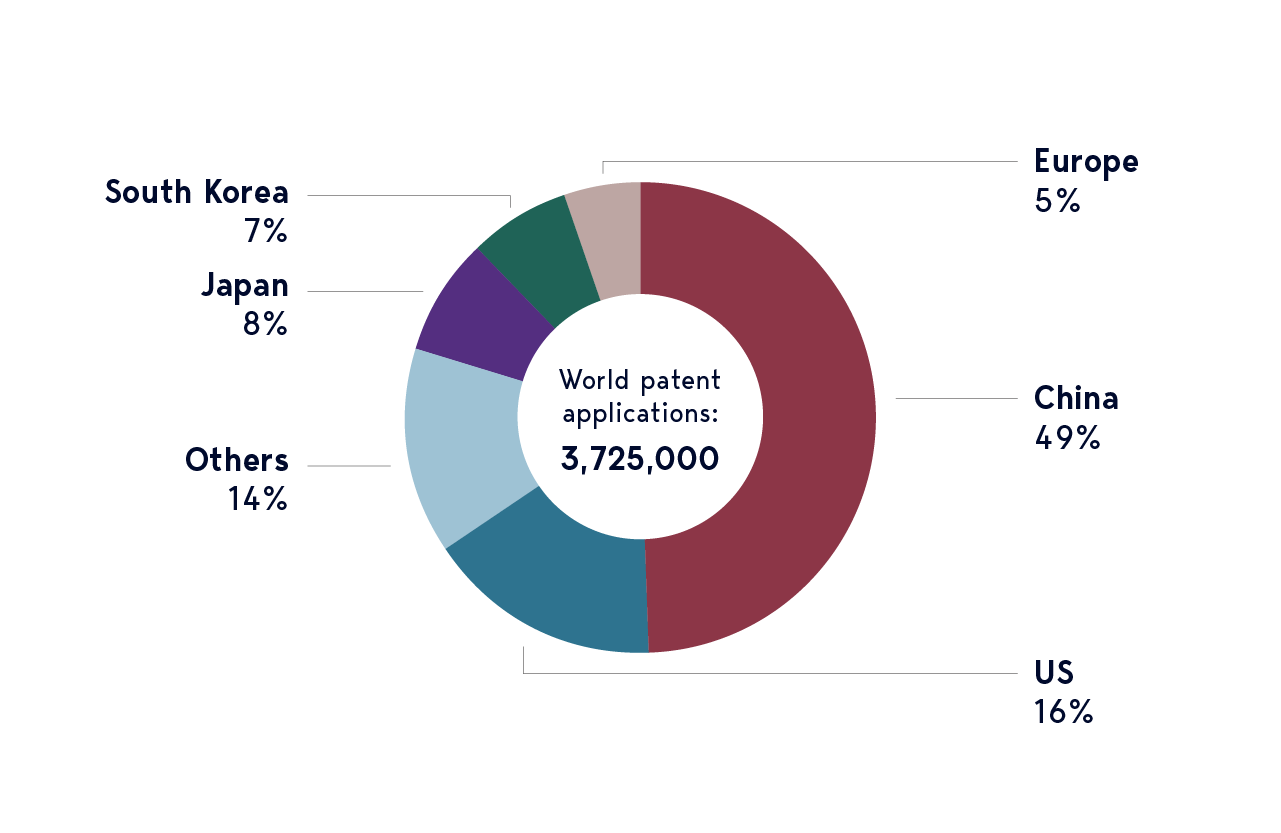
Source: World Intellectual Property Organization, September 2025 (from 2024 data). Filing applications at patent offices.
Successive US export controls have accelerated China’s push for technological self-sufficiency, particularly in semiconductors, where domestic firms are making solid progress replacing Western equipment.
The ascent up the value-added ladder is evident in healthcare equipment too. Domestic players such as Mindray and Edge Medical are emerging as credible competitors to global leaders, as they seek international expansion given the tough backdrop in the domestic market.
Across a variety of sectors, a combination of rapid domestic innovation, intensifying competition, and increasing global ambition among Chinese companies is fostering a push overseas. The travails of several European car manufacturers stand testament to the rapidity with which China’s highly competitive electric vehicles have established a foothold.
Focus on the long term
Looking ahead, we retain a positive view on the longer-term outlook for equities. However, there could be some near-term speedbumps that inhibit the market’s progress. The ‘deal’ between the US and Iran that was once dangled in front of the market, appears to be far out of reach. In the absence of at least some meaningful ceasefire agreement, the consequences of the conflict may begin to reverberate more strongly in months to come.
While not echoing the bearish forebodings of Mr Greenspan, strong gains and elevated valuations in certain sectors suggest a pause for breath could be due. The coming years look to be very exciting for AI, but as with all epoch-making advances in technology there will be periods of volatility and cyclicality. Dissatisfaction with the pace of returns on the mega-investment in the technology could herald a correction in AI names and the broader market. In our view, it is likely that some good long-term opportunities will come not just from companies creating the technology, but from leading businesses deploying it to strengthen their competitive advantages and boost profitability.
AI has been at the forefront of market attention, but bouts of market concentration, coupled with exceptional returns from a small group of companies, can make investors forget the enduring advantages of genuine diversification in a portfolio. Indeed, there are many ‘games in town’, and the market is still replete with opportunities. Across all sectors, leading companies are taking advantage of long-term growth trends that should fuel their earnings for years to come. The fact that some of these have been overlooked in the pursuit of a particular theme can create a compelling opportunity for the long-term investor, in our view.
Important Information
This article is provided for general information only and should not be construed as investment advice or a recommendation. This information does not represent and must not be construed as an offer or a solicitation of an offer to buy or sell securities, commodities and/or any other financial instruments or products. This document may not be used for the purpose of an offer or solicitation in any jurisdiction or in any circumstances in which such an offer or solicitation is unlawful or not authorised.
Stock Examples
The information provided in this article relating to stock examples should not be considered a recommendation to buy or sell any particular security. Any examples discussed are given in the context of the theme being explored.