

L’Oréal’s leadership in the world’s most important beauty market

For use by institutional investors only. Not for use with the general public.
Key takeaways
- L’Oréal dominates the world’s beauty battleground — the US — thanks to unmatched scale, product breadth and brand power
- Its secret weapon? Science and innovation — from new molecules to AI tools reshaping how consumers discover beauty
- With a culture of agility, creativity and deep consumer insight, L’Oréal is well placed to lead the next era of beauty
Success in the global beauty market depends on winning over consumers across the US. Tapping into sustained growth in the world’s largest, and arguably most discerning and demanding, beauty market requires product innovation and marketing zeal. It requires scale and efficiency, and deep financial pockets. Future success will depend on all those attributes, and it will also depend on judicious and strategic use of AI.
Since entering the US market seventy years ago, L’Oréal has demonstrated all those strengths. I returned from a recent three-day investor event in the US, assured that the investments being made today should underwrite future leadership. Through formal presentations, extensive conversations at the company’s innovation centre in New Jersey and more-informal chats with its marketing team, it was hard to not be impressed.
From beauty halls to influencers
Brand experts and retail consultants stress the need for a relationship with customers. The consumer experience has become as talked about as the product being sold. Beauty brands, however, have long recognised the power of these connections — whether through the encouraging advice of an assistant at a department store counter and the opportunity to sample products, or through a YouTuber or TikToker championing a new beauty ‘look’. Products are personal, routines are emotional, and brand loyalty is often tied not just to efficacy but to identity, aspiration and experience. L’Oréal has long recognised this and as the world’s leading beauty company, it has demonstrated its ability to understand and engage with its customers. Time has shown that these relationships aren’t fleeting; they cross generations and geographies and are financially valuable.
Global scale delivers individual choice
L’Oréal’s portfolio of 37 international brands spans mass market, luxury, dermocosmetics and haircare. The company operates in 150 countries and has a presence in drugstores, specialty retail, department stores, salons, and fast growing e-commerce channels. But the true strength of this breadth is not scale for scale’s sake, it is L’Oréal’s ability to serve an extraordinarily diverse set of consumers, at every price point and through every channel they choose to shop. The portfolio is internationally curated, spanning brands from Garnier and Maybelline to Lancôme, Yves Saint Laurent, CeraVe and La Roche-Posay. It allows the company to address different needs, cultures, skin tones, hair types, ages and beauty philosophies.
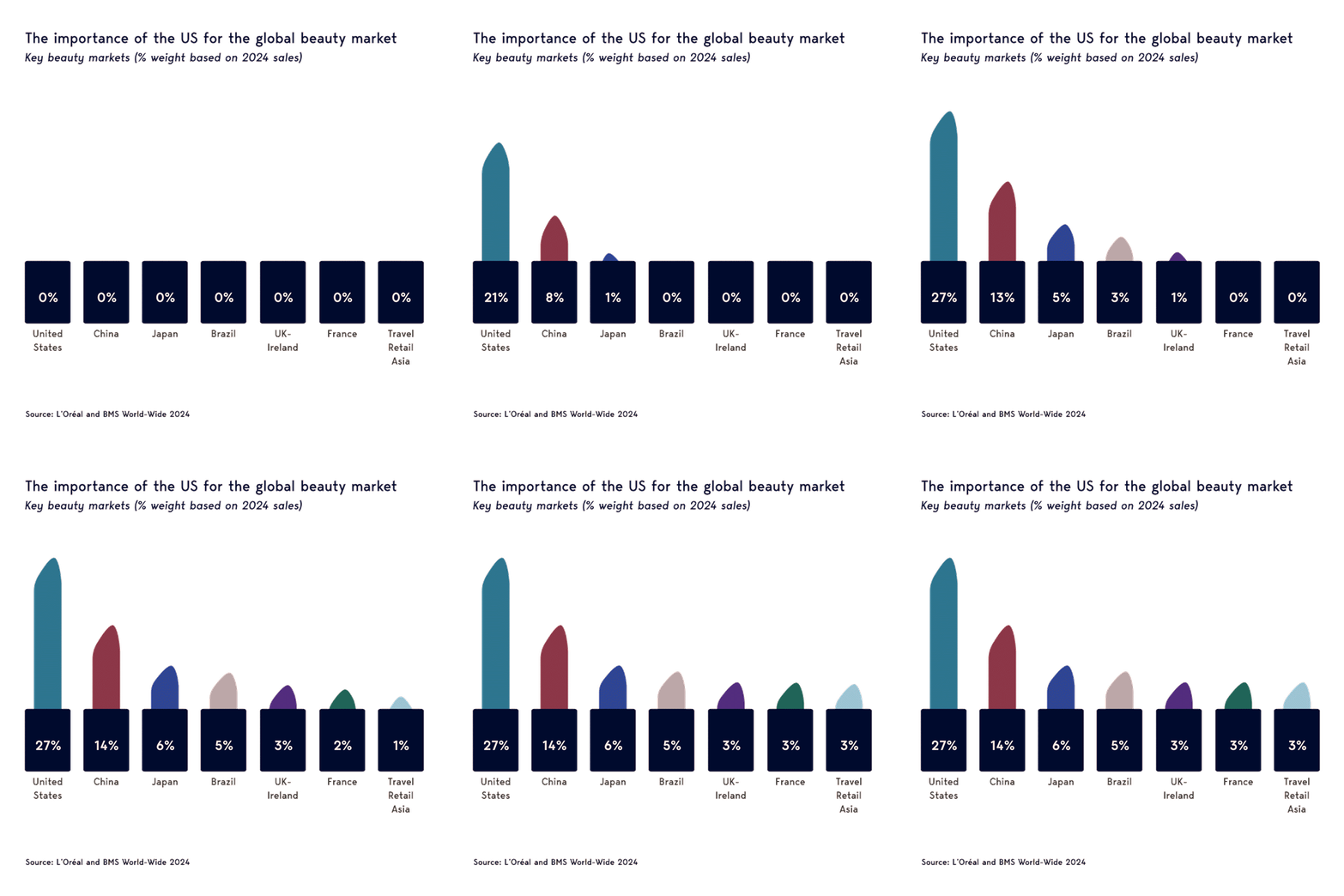
This breadth and depth is particularly important in the US. A consumption powerhouse, the US beauty market is estimated to be almost double the size of the second-largest market in the world, China. The US also represents the largest cohort of affluent customers in the world, and is also arguably the most diverse. During the investor event, L’Oréal profiled the dynamic and diverse nature of the American beauty consumer, highlighting distinct preferences across generations, races and genders and the growing demand for inclusive beauty offerings.
Alongside the all-important US market, the company continues to look to emerging markets to maintain long-term growth. L’Oréal estimates that 45% of its 4.2 billion potential consumers live in these regions today.

The science behind the beauty
Over our three days in New York and New Jersey, one of the most striking themes from across the many presentations was just how deeply science underpins L’Oréal’s product development engine. The company has 21 research centres across 13 countries, and 4,000 scientists. Barriers to entry in the beauty market might be low but that depth of resource is a formidable competitive advantage.
At its New Jersey innovation hub, L’Oréal’s commitment to future development was unmistakable: chemists, bioengineers, packaging specialists and molecular scientists all working at a pace and depth few competitors can match. In 2024, it invested over €1.3bn in research and innovation and its team of scientists filed over 694 patents. Breakthroughs can also be leveraged across all its brands.
One example is Melasyl, a newly developed molecule that addresses pigmentation issues and other dermatological concerns, particularly for darker skin tones, a group often underserved by traditional beauty formulations. Already deployed across multiple brands, it illustrates how scientific investment translates into meaningful, inclusive consumer benefits.
Innovation also extends beyond ingredients. Personalised diagnostics, AI-enabled tools, and technology-driven devices are reshaping how consumers understand and care for their own skin. The L’Oréal Paris Colorsonic at-home hair colouring device is just the latest in a series of products bridging beauty and technology whilst also offering an attractive alternative to its ranges that are focused on hairdressing salons.
Adapting to an ever-shifting beauty landscape
The pace of change driven by digital commerce, social platforms, and now AI, has accelerated dramatically, and again L’Oréal is at an advantage. It has a long history of adapting to a changing retail environment. The company pivoted towards specialty retail earlier than some of its key competitors and it also successfully moved into influencer advocacy and social commerce. It works with more than 50,000 creators.
Those links between the company and those influencers are particularly important for e-commerce which continues to grow faster than physical retail. Again, this is a field in which scale matters and L’Oréal has both the financial reserves and the digital expertise to meet the escalating demands of online merchandising.
Another new area of focus that was highlighted during the event was large language model (LLM) optimised content, the AI era equivalent of SEO (search engine optimisation). Crafting product descriptions so that generative AI tools retrieve them accurately may seem niche today, but it signals a company preparing for the future of digital shopping. With its extensive teams of digital marketeers and data professionals, L’Oréal is thinking several moves ahead.
The medicalisation of beauty
Another of the key themes of the event was the ‘medicalisation’ of beauty. As consumers increasingly treat skin health as part of holistic wellbeing, the boundaries between dermatology, beauty and longevity are blurring. L’Oréal’s upcoming Cell Bioprint diagnostic device is one example of the company’s leadership in this area. It analyses proteins and biomarkers to compare ‘skin age’ with biological age and provides personalised recommendations within minutes. In doing so, this new product and others in the pipeline are moving from treating a problem once it appears to anticipating and preventing issues before they surface.
In parallel, the company has expanded into other devices, supplements and adjacent aesthetic technologies. These range from LED face masks and an AI-powered skin analyser to investments in companies such as Galderma, a leader in injectable aesthetic treatments. L’Oréal is not only selling products but also supporting long-term skin and hair health, a transition aligned with deep consumer trends around wellness, ageing and preventative care.
Looking forward
In recent years L’Oréal has faced challenges. China’s sluggish economy has dampened demand in what is a key market. However, there are now signs of improvement and the tone from management is one of optimism. Results from the all-important US market have also caused disappointment with subdued demand following the beauty boom seen during Covid-19 lockdowns enduring longer than anticipated. However, as with China, recent results have been more encouraging, with the company reporting a re-acceleration in growth and market share gains across categories. Visits during our trip to Walmart, Target, Sephora, Ulta, SalonCentric and Macy’s were a reassuring reminder of L’Oréal dominance in product placement and merchandising.
A more important takeaway from the event, from our standpoint, was the company’s long-term ambitions and positioning. Those are underpinned by its culture, one that was evident across conversations with management, scientists and marketeers.
The company’s culture is entrepreneurial, science driven, learning oriented, and obsessively focused on the consumer. Culture is difficult to measure and even harder to replicate, but it is arguably L’Oréal’s most durable competitive advantage.
Growth will no doubt ebb and flow, and challenges will emerge, as they always do in consumer markets. But L’Oréal’s combination of scale, innovation, adaptability, and deep consumer understanding positions it strongly for the future. The beauty industry is one of the most exciting areas of the global consumer market and we are confident that the company is doing what it needs to today to retain its leadership over many years to come.
Important Information
This article is provided for general information only and should not be construed as investment advice or a recommendation. This information does not represent and must not be construed as an offer or a solicitation of an offer to buy or sell securities, commodities and/or any other financial instruments or products. This document may not be used for the purpose of an offer or solicitation in any jurisdiction or in any circumstances in which such an offer or solicitation is unlawful or not authorised.
Stock Examples
The information provided in this article relating to stock examples should not be considered a recommendation to buy or sell any particular security. Any examples discussed are given in the context of the theme being explored.