

Innovation, competition and opportunity: On the Road in China


For use by institutional investors only. Not for use with the general public.
Key takeaways:
- Investment opportunities in China are expanding as it moves up the innovation ladder, although selectivity is paramount
- Increasingly, it is competing with leading global companies which can no longer treat Chinese competition as a distant threat
- Beyond the technology arena, there are also long-established businesses that are delivering good growth

China is no longer a sleeping giant — when prodded, it innovates
Our paraphrasing of Napoleon’s alleged comment regarding the potential of the Middle Kingdom is an apt description of its recent economic history. The old framing of China as a follower, competing mainly on cost and scale, is an increasingly stale narrative.
Across a wide range of technology and manufacturing fields, China is competing squarely with global peers. In some cases, it is leading outright. In others, it is narrowing the gap with sufficient rapidity that incumbents elsewhere can no longer treat Chinese competition as a distant risk.
This acceleration of China’s capabilities has more recently been a function of geopolitics and economic tensions as the world grapples with the competitive threat posed by its industrial advance. In our view, the very export restrictions and trade tariffs designed to limit China’s progress and intrusion onto the global stage have successfully contributed to an increased focus on innovation and self-sufficiency, aided by Beijing’s economic dirigisme.
China’s export data reflects resilience in the face of hurdles, its manufacturing pre-eminence and, to some extent, the growth in developing market imports of Chinese goods.
Tariffs? What tariffs?
Chinese exports of goods and services 2005-2025 (in current US$ terms)
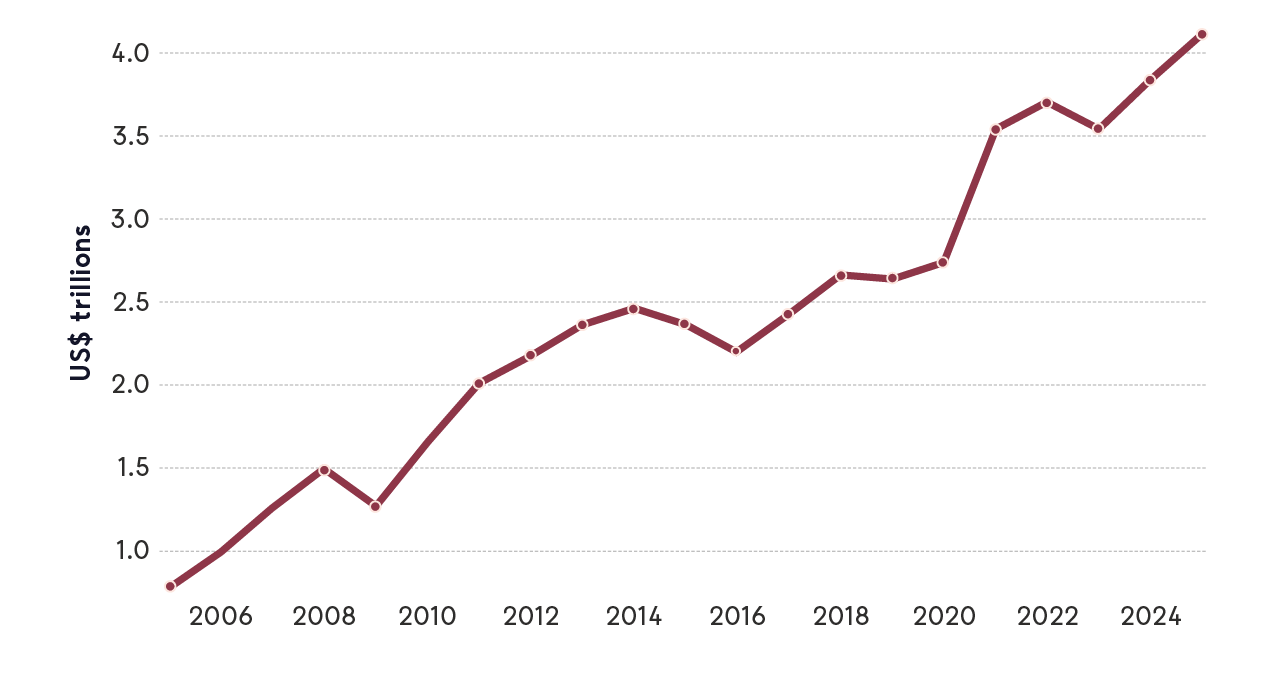
Source: World Bank. Data from 2005 to 2025
Some of the globally prominent businesses we met with on our research trip are well established, such as Lenovo, the world-leading PC maker, which is gaining market share in enterprise servers. Internet giant Tencent has expanded beyond gaming and is integrating its large language model (LLM) framework into its Weixin super app, the domestic version of WeChat. The company’s view is that key ingredients are now in place to enable Tencent to deliver more models at a pace which will position it among the group of open-source model leaders globally.
Other leading companies we met are less well known and still relatively young, but with potentially strong growth prospects. Innoscience, for instance, is a world leader in gallium nitride (GaN) power semiconductors. These are able to handle higher voltages, temperatures, and switching speeds compared to traditional silicon. This has its advantages in wide array of applications from smartphones to advanced computing. Production is ramping up quickly with AI driving demand. This is an example of China leapfrogging an existing technology, with Innoscience investing heavily in GaN well before it was commercial.
A growing competitor
While opportunities in China are expanding, the country’s step up the value-added ladder is potentially shifting the competitive landscape for leading Western, Japanese, and Korean businesses. Medical equipment company Mindray and silicon wafer manufacturer ESWIN were two among a number of companies we visited that are making inroads into markets once the preserve of overseas players.
Not all overseas forays by Chinese companies will succeed, and some markets will remain hard to crack, but the direction of travel is clear enough to warrant close monitoring.
Competition is good...sort of...
The other message from our trip is that stiff domestic competition remains the defining feature of most Chinese industries. This is both a strength and a weakness. It drives innovation and speed-to-market, but it can also destroy return economics. The sectors investors are most excited about today — AI chips, application-specific integrated circuit supply chains, AI models, robotics and related components — are attracting a rush of entrepreneurial energy and capital. That dynamism is admirable, but it also contains a warning.
China has seen this movie before in solar equipment, consumer electronics, batteries, drones, and electric vehicles. The technologies may be different, but the pattern may be the same: rapid capability building, aggressive pricing, falling returns and eventual consolidation around a small number of winners.
In our view, this is less likely to be the case in strategic priority areas such as wafer fabrication equipment tools where the technological bar is exceptionally high and domestic demand can only support gestation of a few players. Also, given social and political prerogatives in China, the government can step in when there is a risk that competition becomes damaging.
Show me the AI money!
Investor sentiment regarding China at the moment is decidedly two-tier. Just about every company we met in AI/robotics-related sectors was bullish and inundated with investor meetings. This contrasts with companies in the rest of the economy, e.g. healthcare, gaming, and industrials, which have largely de-rated, receiving little love from domestic investors, often irrespective of appealing fundamentals.
China has been in the vanguard of the development of AI. It is highly competitive in AI models, particularly open source models. DeepSeek, Zhipu and Qwen are among the current leaders, though leadership continues to shift quickly. Zhipu’s GLM 5.2 release and coding plan attracted particular attention, with performance moving closer to leading Western models.
The larger question remains monetisation. Here, China faces an even tougher challenge than in the West, given intense competition across model providers and technology platforms. Revenues are growing quickly, but remain well behind Anthropic and OpenAI, while profitability is likely weaker.
Model-as-a-service is becoming a bigger part of the market, with Alibaba serving models through its cloud in a similar fashion to Amazon Bedrock. However, China’s history of limited software-as-a-service success, strained cloud economics and persistent hyper-competition suggests monetisation may remain difficult.
Given the current China-US geopolitical divide, the AI hardware space is challenging. China is more semiconductor-limited than the rest of the world. The main bottleneck is local maker SMIC’s foundry capacity, the only player with leading edge technology, so far. Certain users of chips in areas such as automotive industries can still use TSMC.
Robo-frenzy
While we were in China, humanoid robot maker Unitree’s IPO was in progress and a hot topic. Subsequently, the public offering was reportedly 8,000 times oversubscribed by retail investors. We met with two private robotics companies in Booster (R&D and education-related) and Keenon (service robots), and businesses with a robotics programme.
Both companies were clear that while there is a surprisingly large market for R&D and education robots for engineers and hobbyists to play with, the technology is not good enough for broad usage. Hardware is expensive and burns out too often, movements lack the required precision (dancing robots, as popularised by memes, do not require precision), and load bearing remains an issue. This suggests there is a long journey ahead before humanoid robotics becomes an investable area from our perspective.
Hong Kong revival
The principal reason for the Hong Kong leg of our visit was to attend Jardine Matheson’s first capital markets day in its nearly 200-year history. In itself, this event is an indication of the company’s direction of travel. The property, retail, luxury hotel and automotive conglomerate is aiming to make further progress in reshaping its portfolio through asset recycling, selective transactions with a greater focus on diversification, growth, and returns.
More broadly, Hong Kong property has benefited from a more supportive macro environment, including the huge recovery in IPO activity on the Hong Kong stock exchange.
It's hot!
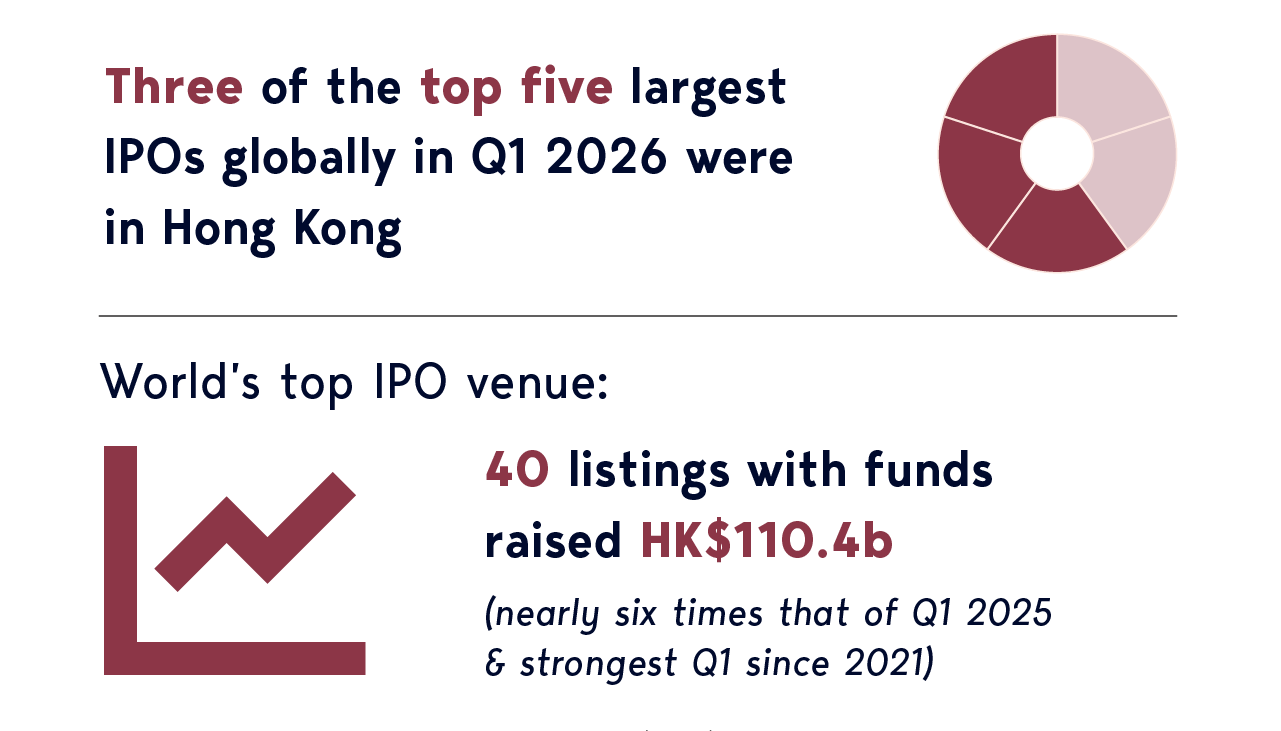
Source: Hong Kong Exchanges and Clearing Ltd (HKEX) quarterly data, April 2026
This has boosted demand for professional services - lawyers, advisors, and investment bankers - and is driving commercial property demand.
On the residential property side, rising population, driven by inflows from the mainland under the highly popular talent visa scheme, is adding further upward pressure on housing demand. Overall, the outlook for Hong Kong’s property market appears positive and that is feeding through into expanding valuations for property companies like Hongkong Land, a subsidiary of Jardine Matheson.
On Hong Kong’s long-term future, Beijing still wants the city to be its offshore finance hub, but within clear and enforceable boundaries. That distinction is important. The crackdown on online brokerages such as Futu and Tiger, reflects a desire to close leaky channels for mainland capital outflows, rather than undermine legitimate, regulated cross-border activity.
While the crackdown impacted sentiment towards pan-Asian insurer AIA Group, the company is fully aligned with regulatory requirements set by the Hong Kong Insurance Authority, with all sales to mainland Chinese customers conducted in person in Hong Kong. AIA does not permit remote customer sales, and therefore avoids the issues faced by online brokerages. As such, AIA is operating firmly within permitted channels established by the regulator - a regulator which in our view is fundamentally supportive of the private insurance industry and recognises its positive societal role.
Carefully optimistic
Our visits to 194-year-old Jardine Matheson and 106-year-old AIA stand in contrast to the swathe of relatively young companies we met with, but it is testament to an evolving Chinese investment universe replete with opportunity. But from our experience it is an environment that requires particular selectivity. China remains a difficult market in terms of finding businesses that can convert growth into durable returns. Competition is fierce, government policy shifts can present hurdles for businesses, and the hottest sectors can often be the ones where the economics are likely to disappoint.
So, while we view the potential opportunity as real, we are not prone to playing prevailing market themes in the absence of strong fundamentals. Across all markets we look for well-run, financially strong businesses that we believe are capable of delivering good returns on a long-term basis. It is a yardstick we apply with equal rigour in China.
Important Information
This article is provided for general information only and should not be construed as investment advice or a recommendation. This information does not represent and must not be construed as an offer or a solicitation of an offer to buy or sell securities, commodities and/or any other financial instruments or products. This document may not be used for the purpose of an offer or solicitation in any jurisdiction or in any circumstances in which such an offer or solicitation is unlawful or not authorised.
Stock Examples
The information provided in this article relating to stock examples should not be considered a recommendation to buy or sell any particular security. Any examples discussed are given in the context of the theme being explored.