

Rethinking global energy demand

For use by institutional investors only. Not for use with the general public.
Key takeaways:
- Energy systems historically expand to meet demand, with new sources added rather than replacing existing ones
- Solar and gas will be important future contributors, reflecting their suitability for evolving demand
- Framing energy as in ‘transition’ understates the reality of a diverse, additive, and increasingly complex system
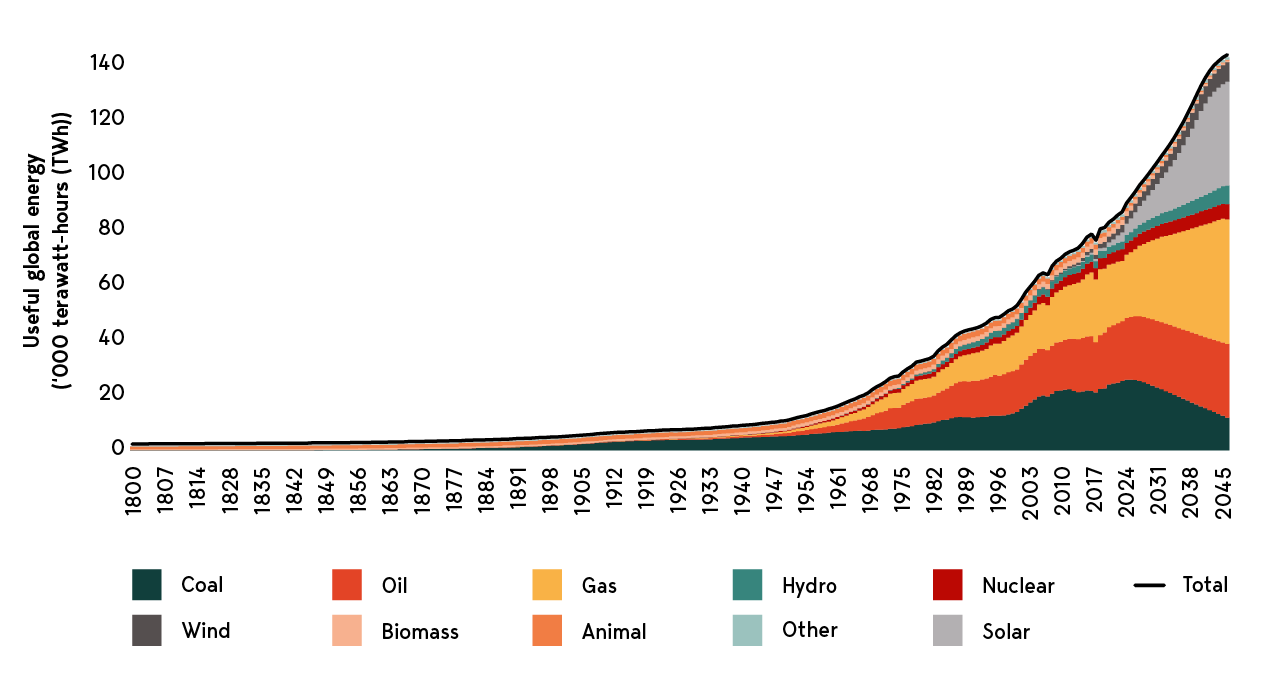
Source: Thunder Said Energy
I used to look at this chart as a series of energy transitions – the rise of coal that unlocked steamboats and mechanisation and railways, followed by the rise of oil that unlocked planes and plastics and cars. The next logical step should be the rise of solar and how it’s going to unlock electric vehicles and many other things. Looking out to 2050, I think a mixture of solar and gas will be the big winner in our energy mix.
But what drove these energy transitions in the past was not supply but demand. Coal dates back to the Han dynasty. Oil was commercialised in the 11th century. Then suddenly there was a demand for pumping machines and trains and that’s what drove the Industrial Revolution. Coal was the perfect resource for those needs because it’s the easiest to burn.
Then when planes and plastics and cars came along, we needed oil to manufacture and power them. So, if we accept that demand is what’s going to drive the future of our energy system, the question becomes: what is the most suitable energy technology to meet that demand?
The chart shows that the answer is a mixture of sources, and that solar and gas are going to be the big winners in our energy mix. But what’s also striking about this chart is that it doesn't really describe an energy transition at all.
Instead, what you see is a very additive process of constantly adding supply up to the point where every new form of energy supply has just been added to the last. It’s an additive process rather than a process of transition.
There’s always a combination and that just speaks to the breadth of the energy system. The idea that one source is going to take the whole cake is not rooted in history. Instead, it’s a story of energy addition, not energy transition.
Rob spoke at the Walter Scott Research Conference in May 2026. This article was written in June 2026 and forms part of the 2026 edition of our Research Journal.
The views and opinions expressed in this article are those of the author and do not necessarily reflect the position of Walter Scott.
Important Information
This article is provided for general information only and should not be construed as investment advice or a recommendation. This information does not represent and must not be construed as an offer or a solicitation of an offer to buy or sell securities, commodities and/or any other financial instruments or products. This document may not be used for the purpose of an offer or solicitation in any jurisdiction or in any circumstances in which such an offer or solicitation is unlawful or not authorised.
Stock Examples
The information provided in this article relating to stock examples should not be considered a recommendation to buy or sell any particular security. Any examples discussed are given in the context of the theme being explored.