

What’s next for China’s economy

For use by institutional investors only. Not for use with the general public.
Key takeaways:
- China’s economy is transitioning from an investment-led model to one based on consumption and services
- To succeed, the country must address deep-rooted barriers to consumption
- No other developing economy has established such an impressive mastery of frontier technologies
Global sentiment about China’s economy tends to swing like a pendulum. In 2022, the dominant narrative was ‘Peak China’. Today the narrative has shifted to a different refrain: ‘China is investable again.’ Both views miss the deeper reality. China is neither simply slowing down nor poised for a straightforward rebound. Instead, it is undergoing a structural transition in which three different economies are unfolding simultaneously: the old, the new, and the future. Understanding China’s economy today requires seeing all three at once.

China is neither simply slowing down nor poised for a straightforward rebound

What does the west get wrong about China? Keyu offers a fresh perspective.
The old model was built on investment in things – industrial expansion, infrastructure deployment, and a booming property sector. At their peak, real estate and related industries accounted for roughly 25-29% of GDP, 16% of urban employment, and around 38% of local government fiscal revenue.
Roughly a quarter of bank lending was tied directly or indirectly to property. From the early 1990s to 2020, Chinese house prices rose tenfold, far outstripping the booms experienced by the likes of Ireland and Spain in the years preceding the GFC.
From the early 1990s to 2020, Chinese house prices rose tenfold
This model worked for as long as the property sector continued to expand. Land sales financed local governments, construction generated employment, and rising property prices boosted household wealth. Crucially, it also powered what was often called the ‘mayor economy’ – a system in which local officials drove growth through aggressive infrastructure and industrial investment, financed largely through land-sale revenues and borrowing from local government financing vehicles linked to the property sector.
Mind the consumption gap
But this growth machine also produced an important side effect: structurally weak consumption. For decades, China’s economic model focused overwhelmingly on expanding supply rather than strengthening demand. Local governments and private firms worked together to create one of the most productive industrial systems in the world. Yet the same system devoted far less attention to providing households with the security needed to spend.
The imbalance is particularly visible in China’s social safety net. Urban retirees receive pension benefits roughly 15 times larger than rural residents, whose basic pension averages only about 240 renminbi per month (around $33). When households face uncertainty about healthcare, retirement, and education costs, they naturally save more. Many are forced to rely on their children, who in turn must cut back on their own spending. The result is an economy that excels at producing but remains cautious about consuming.

Illustrations: Tom Haugomat
The imbalance is striking. While China produces roughly 18% of global output, it accounts for only around 12% of global consumption. On a purchasing-power-parity basis, Chinese consumption amounts to roughly 50-70% of US levels – not as low as many assume. The real gap lies in services. Service consumption as a share of GDP is about 18 percentage points lower than in the United States, highlighting the scale of potential growth in China’s domestic consumer economy.
Chinese households hold more than 60% of their wealth in housing, compared with roughly 30-35% in the United States. In recent years, precautionary savings have continued to rise despite slower income growth. The model – characterised by state-allocated capital, low interest rates, and relatively restrained wage growth – generated abundant output but comparatively weaker household security and consumption.
Frontier China
Yet alongside this slowing legacy economy, another China has emerged – one defined by technological dynamism and innovation. From electric vehicles (EVs) and robotics to semiconductors and artificial intelligence, China has built formidable production capacity. The country now accounts for roughly 30% of global manufacturing value added – the net output of the manufacturing sector. This is the largest share in the world.
Leveraging an ability to innovate at extraordinary speed while operating at a cost and scale advantage that western peers simply cannot match, China now controls more than 70% of global EV production. Battery manufacturers such as CATL are pushing performance boundaries through innovations like its Shenxing ultra-fast-charging battery, capable of adding 320 miles of range in just five minutes.
Another China has emerged – one defined by technological dynamism and innovation
Biotechnology is emerging as another frontier. Bloomberg Intelligence has described China’s biotech industry as nearly as dynamic as its artificial intelligence sector. The digital economy tells a similar story. Several of the world’s most downloaded mobile apps are Chinese, and Chinese-developed large language models are now competing vigorously in the global AI race. Many Chinese LLMs are a fraction of the price of their US peers for often only a very marginal shortfall in overall performance. By some estimates, Anthropic’s Claude Sonnet 4.5 costs six times more per million output tokens than Moonshot AI’s Kimi K2 Thinking model.
This technological momentum did not happen by accident. It reflects a powerful combination of entrepreneurial competition, deep industrial ecosystems, and geopolitical pressure. US export controls and technology restrictions forced Chinese firms to innovate under constraint. Companies that might otherwise have competed independently began investing collectively in domestic alternatives. Huawei’s resurgence in semiconductors and operating systems illustrates how external pressure accelerated domestic technological development.
Beyond the property era
Yet even as technology surges forward, it cannot immediately replace the economic role once played by property. Real estate was never just another sector; it functioned as a financial architecture linking households, banks, and local governments – effectively serving as both a shadow financial system and a shadow fiscal system.
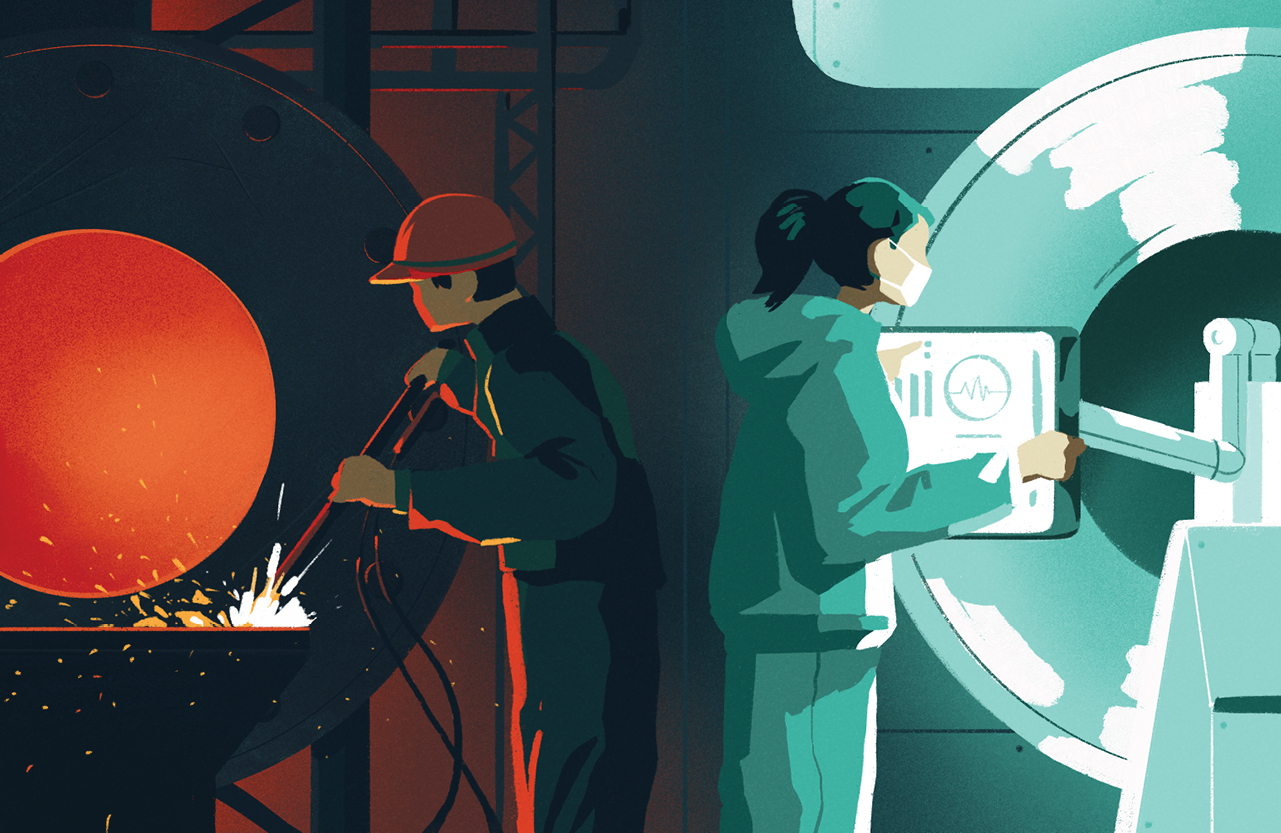
Technology industries are dynamic but structurally different: they do not generate land revenues for municipalities or produce the same credit multiplier effects across the financial system. High-tech manufacturing, for example, currently accounts for only about 6% of GDP. This helps explain why China’s economy today can appear contradictory: a slowing macroeconomy alongside vibrant technological expansion.
Illustrations: Tom Haugomat
Reviving China’s long-term growth will ultimately require addressing its persistent under-consumption problem. Expanding household consumption – and the services sector that accompanies it – is likely to define the next phase of economic development.
The issue is not necessarily a lack of capacity to consume, but rather a lack of willingness to consume, rooted in deeper structural concerns such as economic uncertainty and insufficient social security. The government’s latest Five-Year Plan aims to address these headwinds to consumption by expanding household incomes and social protections – including potential increases to rural pensions.
Towards a new growth model
In this sense, China’s transition can be understood as a shift in priorities. If the old growth model was about investing in things, the next phase will increasingly be about investing in people. That means expanding sectors tied directly to household wellbeing and consumption, including healthcare, education, tourism, and elderly care. It will also involve new forms of consumption linked to digital services and experiential spending, as well as demand for greener and smarter products.
The next phase will increasingly be about investing in people... sectors tied directly to household wellbeing and consumption, including healthcare
Another potential lever for boosting consumption lies in capital markets. Policymakers are attempting to redirect household wealth away from property and towards financial assets. China’s stock market capitalisation relative to GDP currently stands well below the rate typical in advanced economies. Long-term plans envisage deepening capital markets as a channel for household wealth accumulation and innovation financing.
Transitions on this scale are rarely smooth. The old model weakens before the new one fully takes shape, creating the illusion of stagnation. China is entering a new economic era defined by the end of several powerful tailwinds:
- a post-demographic dividend phase as population growth turns negative;
- a post-urbanisation phase as the great migration from countryside to city slows;
- a post-property era as the real estate sector loses its central role in the growth model;
- a post-peak-globalisation environment in which external demand can no longer expand as effortlessly as before.
But the real test for any developing economy is whether it can move beyond manufacturing into genuine technological leadership. On that front, China has already crossed a threshold. No country at a comparable stage of development has built such breadth and depth in frontier technologies. If history is any guide, that achievement may matter far more for China’s long-term trajectory than the cyclical slowdowns dominating today’s headlines.
Keyu spoke at the Walter Scott Research Conference in May 2026. This article was written in April 2026 and forms part of the 2026 edition of our Research Journal.
The views and opinions expressed in this article are those of the author and do not necessarily reflect the position of Walter Scott.
Important Information
This article is provided for general information only and should not be construed as investment advice or a recommendation. This information does not represent and must not be construed as an offer or a solicitation of an offer to buy or sell securities, commodities and/or any other financial instruments or products. This document may not be used for the purpose of an offer or solicitation in any jurisdiction or in any circumstances in which such an offer or solicitation is unlawful or not authorised.
Stock Examples
The information provided in this article relating to stock examples should not be considered a recommendation to buy or sell any particular security. Any examples discussed are given in the context of the theme being explored.