

Where next for the AI buildout?

For use by institutional investors only. Not for use with the general public.
Key takeaways:
- The AI infrastructure buildout is coming under increasing scrutiny
- Moderation looks the most plausible next phase of the cycle
- Investors should understand where companies sit in the spending chain
Equity markets have experienced a period of heightened volatility as investors question the sustainability of the AI capex boom. The enthusiasm that has helped propel markets in recent years has, for now, given way to a more sober assessment of the risks and returns associated with the AI build-out.
In our view, this makes for an appropriate juncture to try and put the past few weeks in context and consider what they might mean for the long-term health of the AI theme.
It also seems an opportune moment to take stock of how we at Walter Scott are thinking about AI: where we see the opportunities, where we see the risks, and how those views are being expressed in portfolios.
Tough questions getting tougher
It is worth remembering that the volatility of recent weeks did not come entirely out of the blue. Signs of strain had been appearing in the AI ecosystem for some time.
Ever-larger spending commitments were no longer greeted as unambiguously good news. Instead, investors began looking at the enormous sums being deployed through the rather less forgiving lens of cash flow and prospective returns – particularly for those companies deemed to be trading at rich valuations.
That scrutiny becomes harder to shrug off when money is expensive. If the cost of capital stays higher for longer, or rises further, investors are entitled to ask some fairly basic questions. Most pertinently, perhaps, will revenue grow fast enough to justify the current pace of investment? Investment and monetisation do not always move neatly in tandem, creating the potential for bouts of overinvestment, digestion and cyclicality.
The US midterms and Jensen Huang’s travails only made such questions more pressing.
AI scepticism comes to Washington
Of the more than 40 data centre measures put to voters across 10 states in November’s election, all but one resulted in a vote against development. For now, data centres are political kryptonite across much of the US.
Armed with this anti-AI mandate, the incoming Democratic Congress is likely to pursue tougher industry regulation. President Trump can, of course, veto federal legislation, but has little leverage at the state or local level. The ructions at Nvidia – and the still unknown ramifications – will only strengthen the resolve of lawmakers.
Much as political prognosticating is not our bailiwick, we think it reasonable to conclude the US is nearing the end of its anything-goes policy era.
If you build it...
The number of US data centres is expected to grow 5x in a decade
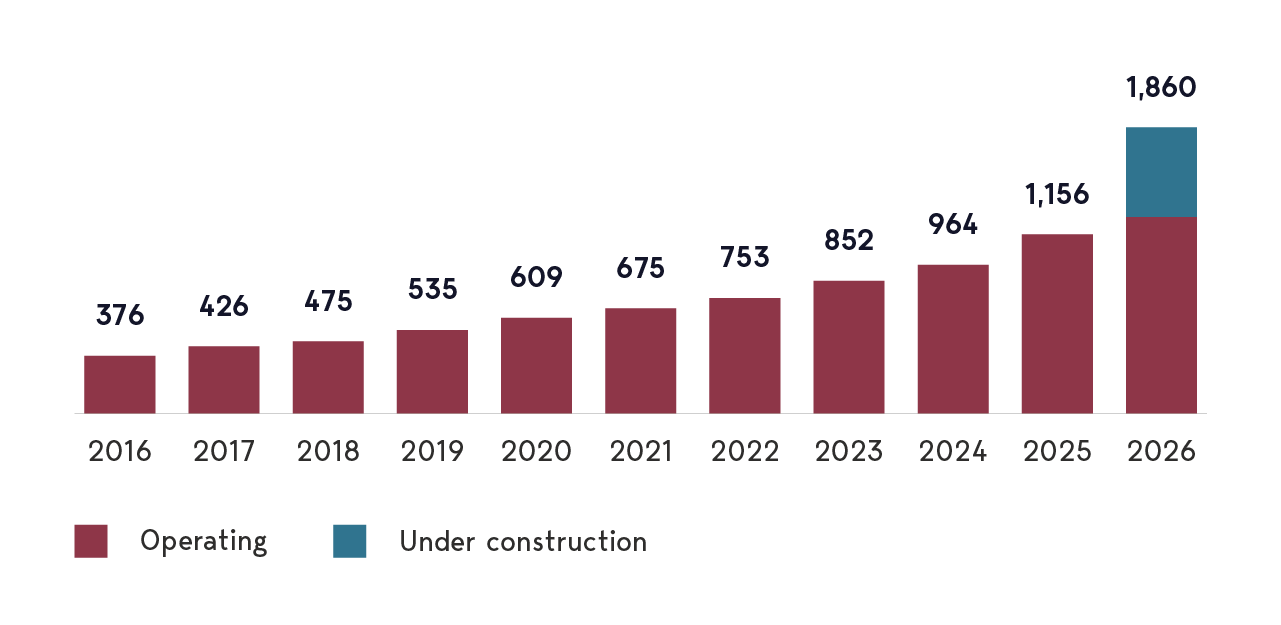
Source: Cleanview November 2026
We should stress that this does not alter our view that AI represents a significant structural opportunity. But it does reinforce our belief in the need to be selective. As with every technological revolution, the rewards will not be evenly distributed, and the journey for investors is unlikely to be smooth.
Where do we go from here?
We have been thinking about three broad scenarios for the next phase of AI investment: continued boom, moderation and downturn, and what each might mean for the companies we own.
Of the three, moderation strikes us as most plausible. We think it unlikely that the extraordinary growth in AI investment of recent years can continue indefinitely. At some point, financing constraints, the need to demonstrate returns and the physical limits of supply chains will begin to bite. Recent events have only strengthened this view.
That need not be bad news. Indeed, a slowdown from today’s frenetic pace might ultimately prove healthier: extending the investment cycle, reducing its reliance on debt and forcing greater discipline over where capital is deployed.
Regardless of the path of the infrastructure buildout, it’s important for investors to understand where a company sits in the AI value chain. One way we think about this is to ask a simple question: when does it get paid?
Broadly, our AI-related holdings fall into three groups:
- Paid when AI is used. Think Microsoft, where greater adoption can translate into increased demand for cloud computing, software and AI services.
- Paid when AI capacity is built. Think TSMC, whose advanced manufacturing capabilities are required to produce the chips used to train and run AI models.
- Paid for the equipment to build capacity. Think ASML, whose lithography systems are essential to producing the world’s most advanced semiconductors.
We view this distinction as important; a company whose fortunes depend heavily on the next dollar of capital spending is exposed to a different set of risks from one that gets paid as AI adoption broadens. The closer a business sits to the buildout, the more exposed it is to the ebb and flow of the investment cycle.
This is not an argument for avoiding AI infrastructure. We believe exceptional businesses exist throughout the value chain. But we do think a more moderate spending environment puts an even greater premium on selectivity, particularly around valuation and the durability of growth.
The market contains multitudes
Our objective, however, is not to align our AI exposure with one scenario. Nor are we trying to call the next turn in the cycle. What we want is to own businesses capable of prospering under a range of outcomes, while ensuring that the price we pay reflects the risks we are taking. This also means optimising exposures as the cycle evolves, leaning into different parts of the chain when appropriate.
But building a portfolio for the long term means looking beyond AI; genuine resilience, we believe, requires meaningful exposure to companies whose prospects are driven by different, largely unrelated forces.
Revolutionary technology it may be, but AI is not the only game in town. We continue to find compelling businesses across a range of industries benefiting from diverse and durable sources of long-term growth. Many of these companies have, in our view, been overlooked amid investors’ intense focus on AI. If recent volatility marks the emergence of a market more discerning about where growth and long-term returns reside, that would be no bad thing.
Important Information
This article is provided for general information only and should not be construed as investment advice or a recommendation. This information does not represent and must not be construed as an offer or a solicitation of an offer to buy or sell securities, commodities and/or any other financial instruments or products. This document may not be used for the purpose of an offer or solicitation in any jurisdiction or in any circumstances in which such an offer or solicitation is unlawful or not authorised.
Stock Examples
The information provided in this article relating to stock examples should not be considered a recommendation to buy or sell any particular security. Any examples discussed are given in the context of the theme being explored.